What the church means when she refers to deacons as ministers of sacrament is, in one sense, fairly straightforward: How does the deacon participate in the sacramental life of the church? In answer to that question, one can often rather simply just list the various sacramental functions of our public worship -- as I did in the last post -- and speak to the various roles of the deacon in their celebration.
However, in my opinion, we need to then broaden the discussion back to where we started in the first post in this series: that for Catholics, "sacramentality" means much more than simply "the seven sacraments of the church." Sacramentality, as you will recall, is grounded in Christ, the ursakrament or the fundamental sacrament of our encounter with God. The entire "sacramental life" of the Church, in all of her members, flows from this relationship with Christ.
So, looking at the deacon, then, we might ask: How does the deacon "sacramentalize" for the Christian community this encounter with Christ? Pope John Paul II, writing about the human dimension of the formation of presbyters, used the image of a bridge: that the ordained minister needs to be a bridge for people in their encounter with Christ, and not an obstacle to that encounter (see Pastores Dabo Vobis); in subequent documents, the Holy See and USCCB have developed this idea for diaconate formation as well.
How can deacons be this "bridge" leading others to Christ? There are many ways, of course, including the deacon's liturgical and sacramental roles. However, equally important (and some would say, even more important) are the various ministries and "apostolic works" in which the deacon is engaged in the service of others in the community. This will be subject of our next series on the deacon's participation in triple munus of ordained ministry, when we turn our attention to the deacon as Minister of Charity and Justice.
Friday, January 7, 2011

Tuesday, January 4, 2011
The Deacon as Minister of Sacrament -- Part II
Sacraments, it has been said, "effect what they signify." For Catholics, Orthodox and certain other churches and denominations, a sacramental life is central to Christian discipleship, and even Catholic canon law speaks of the "right" that Christians have to the celebration of the sacraments. We usually speak of the seven sacraments in terms of their overall function in the life of the church: sacraments of initiation are baptism, confirmation and eucharist; sacraments of reconciliation are reconciliation ("confession") and anointing of the sick; and the sacraments of vocation are matrimony and order.
Although we don't like to reduce things to pure functionality, we have to do that a little bit. It's important to remember, however, that there are usually three dimensions to ALL sacraments: they are OUTWARD signs, connected with Christ, that effectively communicate God's grace. The sacraments are always PUBLIC events; there is no such thing as a "private" sacrament.
 Down to function:
Bishops may preside at all sacraments, including ordination of other ministers.
Presbyters preside over all sacraments, except ordination. While bishops are the original ministers of confirmation, presbyters may do so with proper delegation through canon law and the bishop.
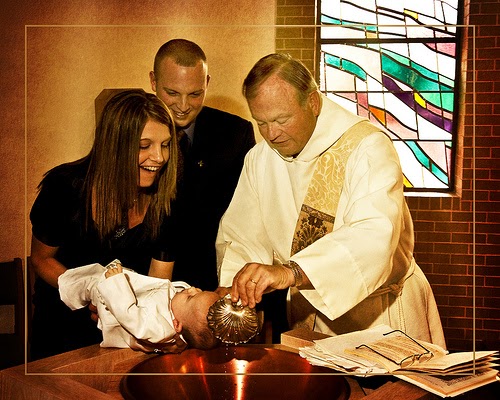
Deacons preside over baptism and matrimony. Deacons do not confirm, do not preside over the Eucharist, do not hear confessions, do not anoint and do not ordain. Deacon do have, however, their own specific assisting roles in other sacraments, such as at the Eucharist or in anointing or at ordinations.
As ordained ministers, deacons also have other liturgical functions as well. Deacons are ordinary ministers of holy communion; deacons preside over communal celebrations of the Liturgy of the Hours, deacons preside at Benediction and may give the Eucharistic Benediction (lay persons may not), and deacons conduct wake services and funerals.
The role of the deacon, even while presiding, is to act in the person of Christ the Servant and in the name of the Church.
Although we don't like to reduce things to pure functionality, we have to do that a little bit. It's important to remember, however, that there are usually three dimensions to ALL sacraments: they are OUTWARD signs, connected with Christ, that effectively communicate God's grace. The sacraments are always PUBLIC events; there is no such thing as a "private" sacrament.
Bishops may preside at all sacraments, including ordination of other ministers.
Presbyters preside over all sacraments, except ordination. While bishops are the original ministers of confirmation, presbyters may do so with proper delegation through canon law and the bishop.
Deacons preside over baptism and matrimony. Deacons do not confirm, do not preside over the Eucharist, do not hear confessions, do not anoint and do not ordain. Deacon do have, however, their own specific assisting roles in other sacraments, such as at the Eucharist or in anointing or at ordinations.
As ordained ministers, deacons also have other liturgical functions as well. Deacons are ordinary ministers of holy communion; deacons preside over communal celebrations of the Liturgy of the Hours, deacons preside at Benediction and may give the Eucharistic Benediction (lay persons may not), and deacons conduct wake services and funerals.
The role of the deacon, even while presiding, is to act in the person of Christ the Servant and in the name of the Church.
Friday, December 31, 2010
The Deacon as Minister of Sacrament -- Part I
Ordination brings the ordinand into a new set of responsibilities in service of the People of God. This is usually referred to as a participation in the triple munus (function) of Word, Sacrament and Charity. Before Christmas we looked at the role of the deacon as a minister of the Word of God. Now I want to move into some reflection on the deacon as a minister of sacrament.
To do that, of course, we need to understand what we mean by "sacrament." So, here's a very, very brief "Sacraments 101".

1) Theologian Joseph Martos has referred to sacraments as "doors to the sacred" and that's a pretty good phrase. The underlying understanding of sacrament in the Catholic sense is that a sacrament "connects" the human and the divine. Another theologian, Robert Taft, SJ, once tried to describe a "symbol." He evoked Michelangelo's famous painting of the creation of Adam from the Sistine Chapel. Taft points out that God's finger, stretched out toward Adam, and Adam's finger, stretched out toward God, do not touch; there is a gap. For Taft, a "symbol" CONNECTS the two. In many ways, this can also describe our sense of sacrament as that which connects the human and the divine.
2) Prior to the Second Vatican Council, theologians began describing a deeper sense of sacramentality than most people appreciated. The bishops at the Council adopted much of this language in their own documents. So, in addition to the seven sacraments of the church, we first speak of Christ himself as the most fundamental sacrament of all: Christ IS the connection between God and humanity. The Church itself can be understood as a sacrament of our encounter with Christ, and then the seven sacraments of the church represent special encounters with Christ. We also speak today of the "sacramental principle": that understanding that all of God's creation can serve as vehicles of God's life. That's why we make such liberal use of ordinary things like water, wine, bread, oil, touch and so on.

3) Finally, the word "sacrament" itself comes from the Latin word sacramentum. A sacramentum in the Roman Empire was the oath of enlistment taken by a new recruit into the army, and early Christian writers began referring to Christian initiation as a sacramentum. For those of us who have served in the military, this analogy works very, very well! Consider what happens when a person enlists in the military: That person swears a solemn oath, after which his or her old civilian clothing is taken away. The person is given new clothes -- a uniform -- which communicates the person's new status. This uniform identifies the person's relationship to others (their relative rank and specialization, for example), and without any words at all, the simple fact that the person is now in service to an authority other than himself.

Now look at early Christian baptism: The catechumen states his or her intent to a new relationship with God. The person's old, "civilian" clothes are taken away and the catechumen, naked, enters the baptismal pool where the "sacramentum" (oath) is taken; we call it the Creed today! Then the neophyte is led from the pool, and given his new "uniform" of a white garment which marks the person as a new person in Christ. No longer acting on their own authority, they are now Christ's and have been immersed into the very life of the Trinity. Now part of God's own life, the neophyte is led fro
m the pool to the Eucharistic table to complete his or her initiation.
It is against this sense of "sacrament" that we can now turn to the role of the deacon in the sacramental life of the Church.
Thursday, December 30, 2010
Welcome Back!
I hope everyone is enjoying a wonderful Christmas Season. I have deliberately not been posting much out of respect to the Holy Season. However, I will begin a new series shortly, probably later today, so check back soon!
I will be moving into the deacon's ministry of Sacrament.
God bless,
Bill
I will be moving into the deacon's ministry of Sacrament.
God bless,
Bill
Friday, December 24, 2010
Christmas Greetings
May Almighty God bless you and your families in a most special and joyful way during this season of Christmas.

Tuesday, December 21, 2010
Deacon as Minister of the Word of God, Part III

We have reflected upon the deacon and his role of proclaiming the Gospel and on his responsibilities as a preacher at Mass. Now we turn our attention to other dimensions of the deacon's service as a minister of the Word; specifically, in this posting, the deacon's role as an official teacher of the church. The deacon's catechetical role flows from the same charge given to him by the bishop. While some deacons do not consider themselves teachers, and a few might even argue loudly that they are not! However, that doesn't change the fact that the church sees all ordained ministers as teachers, and as with most things the deacon does, his responsibilities as teacher flow from his relationship to the bishop, who is the prime teacher of the faith in the diocese.

Our second example is similar. In this case, still another deacon from Carthage, this one named "Quodvultdeus" writes to Bishop Augustine informing him that the bishop of Carthage has asked the deacon to preach the Lenten homilies, and the deacon asked for Augustine's advice (I like to think that Quodvultdeus heard from his buddy Deogratias about how helpful Augustine had been to him!). In this case, however, we don't have a document from Augustine in answer to the deacon's question; but we do have the deacon's homilies! So it is possible to study them and discern Augustinian influence. But again, for our purposes here, it's illuminating to see that the deacon is again taking on preaching/teaching responsibility on behalf of his bishop -- and that this is seen as a normal activity of the deacon.
So, for our reflection today, those of us who are deacons can ask ourselves how well we handle our catechetical responsibilities. First, do we embrace them eagerly and passionately as a constitutive component of our ministries? Second, do we continue to seek opportunities for ongoing formation, just as our predecessors turned to a master teacher for advice? Third, how well do we teach, helping others find the practical applications of the Gospel in every day life. Such ministry is part and parcel of the charge given to us at ordination.
Saturday, December 18, 2010
Deacon as Minister of the Word of God, Part II

Subscribe to:
Posts (Atom)